
Tuolumne Scheduled vs Actual Release
A projected release date is not the same as an actual release. Projected means the expected date based on sentence, credits, parole eligibility, or agency calculation. Actual release means the person has completed custody processing and left that agency's custody. In Tuolumne County, a projected jail release still has to pass paperwork review, identity checks, warrant checks, property return, and release-log updates at Dambacher.
A court sentence date or CDCR eligibility date can change before the actual release record is created.
Find a Tuolumne Release Date
Use the custody source first. The county jail, CDCR, BOP, and ICE do not share one release-date calculator. Tuolumne Superior Court can explain sentence or disposition, but the jail or prison agency documents the custody release.
- Check whether the person is currently in Tuolumne County jail custody.
- For a county jail sentence, ask the Sheriff's custody or records path for booking and release information.
- Check Tuolumne Superior Court Criminal Division for sentence, bail, warrant, or disposition records.
- For a CDCR prisoner, search CIRIS and review BPH parole-eligibility terms.
- Use VINELink for release or transfer alerts when the person is still trackable.
CDCR Dates for Tuolumne Cases
CDCR and BPH use date terms that do not apply to ordinary county jail release. BPH explains Earliest Possible Release Date, Minimum Eligible Parole Date, Nonviolent Parole Eligible Date, Youth Parole Eligible Date, Elderly Parole Eligible Date, and controlling parole eligible date. Those dates can matter for a person at Sierra Conservation Center or another CDCR prison.
The BPH parole eligibility page explains these public date terms.
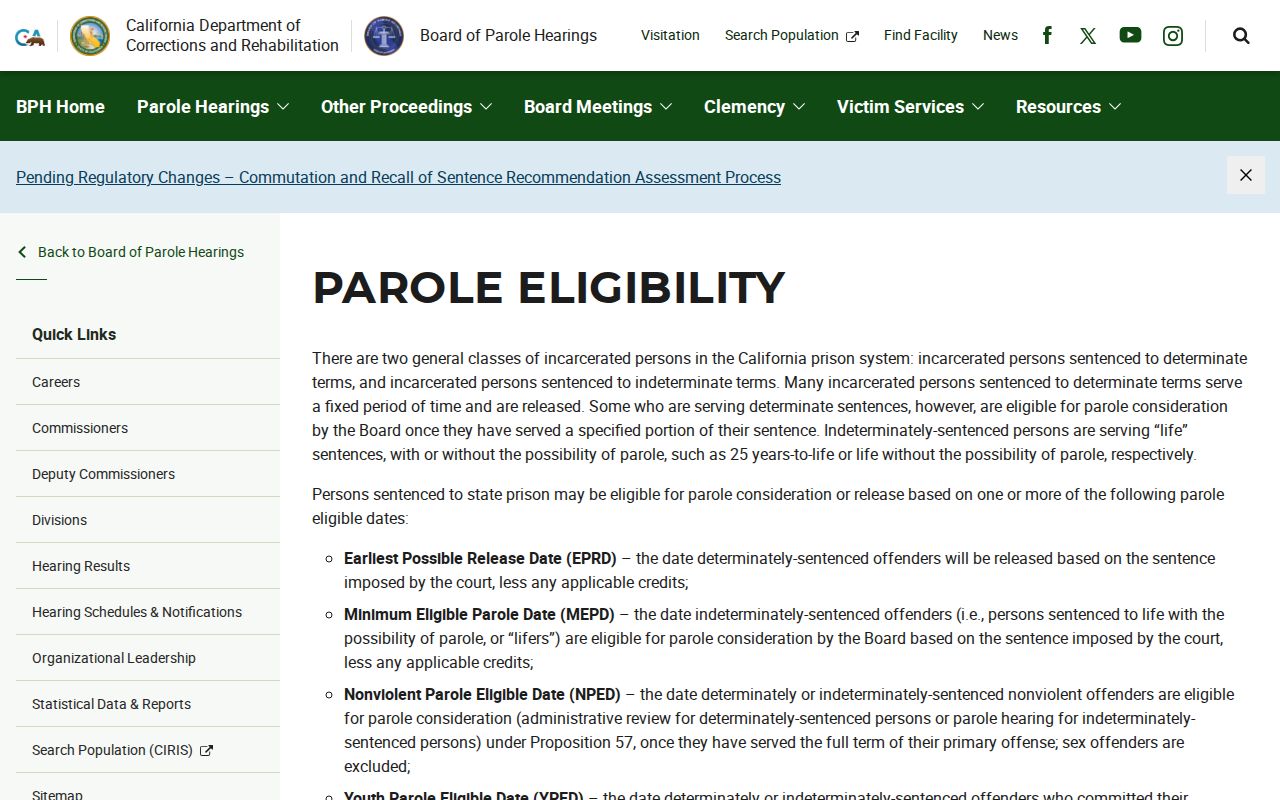
BPH eligibility dates are not a jail release list. They show parole or release consideration within the state-prison system.
Good Time and Earned Credit
California Penal Code section 4019 provides the county-jail conduct and work credit framework. For state prison, Penal Code section 2933 covers worktime credits for determinate sentences, and Penal Code section 2933.1 limits worktime credit to no more than 15 percent for listed violent felonies. Life-sentence and parole eligibility rules can also involve Penal Code sections 3046, 3051, and 3055 depending on the sentence.
Credits are not self-executing public guesses. Jail or CDCR staff must calculate, review, and apply them to the correct sentence, hold, and release authority. The Tuolumne custody manual specifically mentions good-time calculation review before release.
Why Tuolumne Dates Change
| Change factor | How it affects release |
|---|---|
| New warrant or hold | Can block or redirect release even after another sentence ends. |
| Credit change | Good-time review can move a jail or prison date. |
| Court order | Can release, remand, modify bail, or impose a sentence. |
| Transfer | Moves the release-date question to CDCR, BOP, ICE, or another agency. |
| Parole hearing outcome | Can grant, deny, waive, postpone, or reschedule a state-prison parole event. |
County Jail Date Limits
A pretrial detainee at Dambacher usually has no fixed release date unless bail, own-recognizance release, dismissal, plea, sentence, or another court order creates one. A sentenced county jail inmate may have a date based on the judgment and credits. The Sheriff's record and the court file should be reconciled because one shows the custody action and the other explains the legal reason.
Note: For past release confirmation, use the release record and Tuolumne County released inmates search path rather than a projected date alone.
Dambacher Good-Time Review
The Tuolumne custody manual specifically lists good-time calculation review and release-date adjustment review as parts of the release process. That matters for a county jail sentence because the projected date may depend on sentence length, credits, court orders, pending holds, and any later adjustment. A person can be close to a projected release date and still remain in custody if a warrant check, outside agency hold, or paperwork issue changes the result.
For a records request, ask for the scheduled release date, actual release date and time, manner of release, and any public booking fields that explain the custody event. Do not ask the Sheriff's records unit to calculate a legal opinion. Ask for the record it maintains.
Tuolumne Court Date Records
The court record is often the missing piece for projected release questions. The criminal division page says the court maintains filings and records of dispositions, and copy requests may be made with the defendant name, date of birth, case number if known, requested documents, payment, and a self-addressed stamped envelope. A sentencing minute order, disposition, or bail order can explain why a jail date changed.
The online calendar is useful for immediate hearing activity because it is updated during the day and shows the current day through the next seven days. It should not be treated as a long-term release-date archive. For that, use copies from the court file and the Sheriff's release record.
BPH Eligibility Is Not Release
BPH parole-eligible dates are public concepts, but they are not the same as guaranteed release dates. EPRD, MEPD, NPED, YPED, EPED, and the controlling parole eligible date describe when a person may become eligible for release consideration or a parole process within CDCR. A hearing can be granted, denied, waived, postponed, or continued. Some grants may also be subject to review.
For a Tuolumne County searcher, this distinction is critical. Sierra Conservation Center is in Tuolumne County, but it is a CDCR prison. Use CDCR and BPH records for eligibility. Use DAPO for parole supervision. Use Sheriff's records only when the person was held at the county jail.
VINE for Date Changes
VINELink does not calculate a projected release date, but it can notify a registered user when custody status changes. That makes it useful when a projected date is near and the person is still in a participating custody system. Register before the expected date, complete the confirmation or PIN step, and keep agency records for proof.
If VINE sends an alert, verify the result with the jail, CDCR, court, or receiving agency. Notifications can lag, and a transfer alert is not the same as final discharge.
Federal Release Date Fallbacks
Most Tuolumne County release-date questions are local jail or CDCR questions, but federal custody can appear when a local arrest connects to a federal case. The BOP locator covers federal inmates from 1982 to the present. BOP explains that a past release date with no facility location can confirm release from BOP custody on that date, while a future date may be projected and subject to change.
USMS pretrial custody is different from BOP sentenced custody. The Marshals Service houses federal pretrial prisoners in federal, state, local, and private facilities, so a person can be physically housed outside a BOP facility while the federal case is still active. Use federal court or agency context before assuming BOP will answer every federal date question.
ICE Date Limits
ICE ODLS is not a general release-date calculator. It is designed to locate people currently in ICE custody or, through related help materials, those recently released for a short period. If a Tuolumne County jail release was actually a transfer to immigration custody, the Sheriff's record may show the local release or pickup, while ODLS addresses immigration custody. The two records should be reconciled instead of merged.
For ordinary county jail releases, do not use ICE. Use the Sheriff's custody record, court disposition, and VINE when available. ICE is only relevant when the facts show immigration detention or a transfer to that system.
ICE Date Limits
ICE ODLS is not a general release-date calculator. It is designed to locate people currently in ICE custody or, through related help materials, those recently released for a short period. If a Tuolumne County jail release was actually a transfer to immigration custody, the Sheriff's record may show the local release or pickup, while ODLS addresses immigration custody. The two records should be reconciled instead of merged.
For ordinary county jail releases, do not use ICE. Use the Sheriff's custody record, court disposition, and VINE when available. ICE is only relevant when the facts show immigration detention or a transfer to that system.
Public Record Search
Sponsored Results